ParkerPlus AI
Category :
AI-Powered, Parking Violation, Public Services, Responsive
Role :
UX / UI Designer
Timeline :
2025 - 2026 Ongoing
Delivery :
Research, Planning, Design, Prototyping, Testing
A Major Problem
Paying or disputing a parking ticket shouldn't feel harder than the ticket itself. Drivers need a faster way to find, pay, or challenge tickets, but outdated government websites often slow them down with confusing navigation and inefficient workflows. On top of that, many users don't learn about a ticket until it arrives in the mail or wait days for a newly issued ticket to appear in the system, allowing late fees to accumulate. ParkerPlus AI was designed to remove these frustrations by helping users resolve parking tickets quickly, confidently, and before unnecessary costs add up.

Research Synthesis
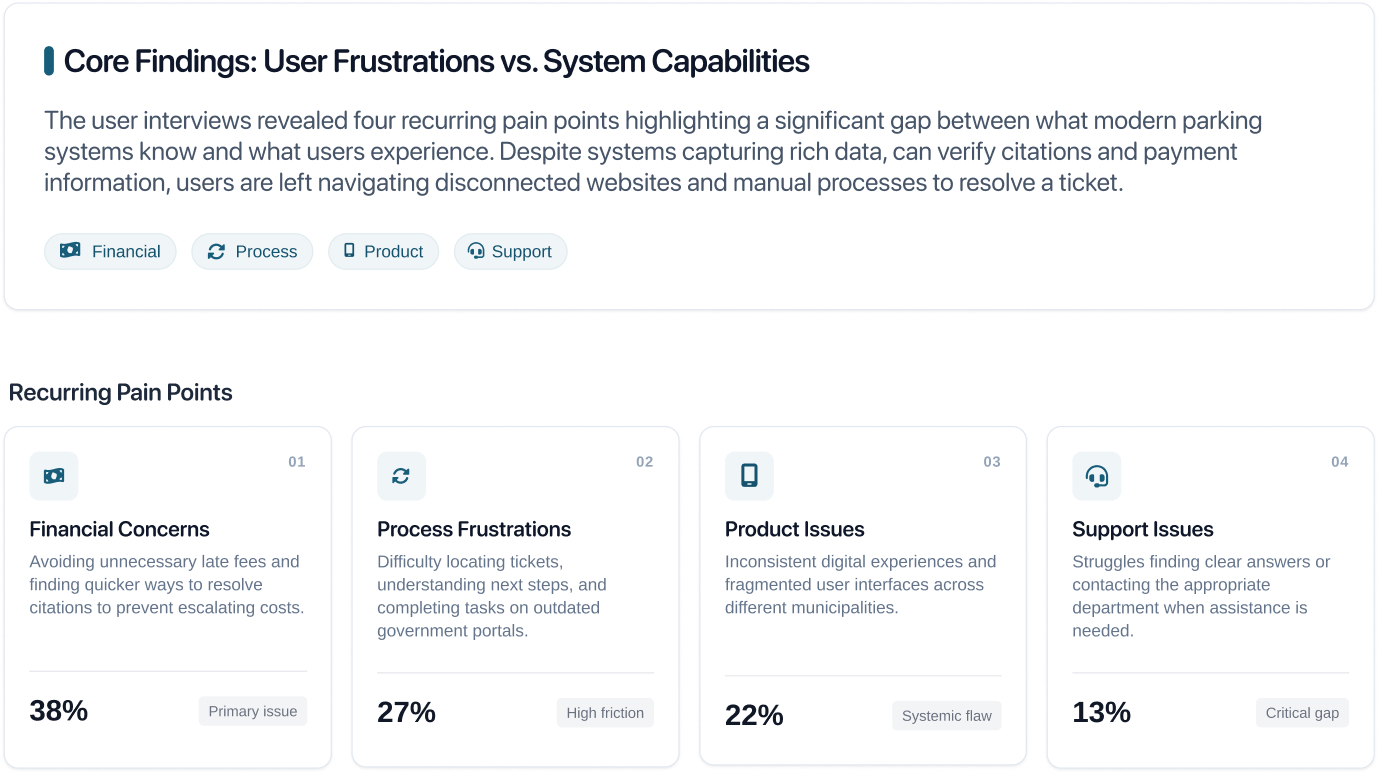
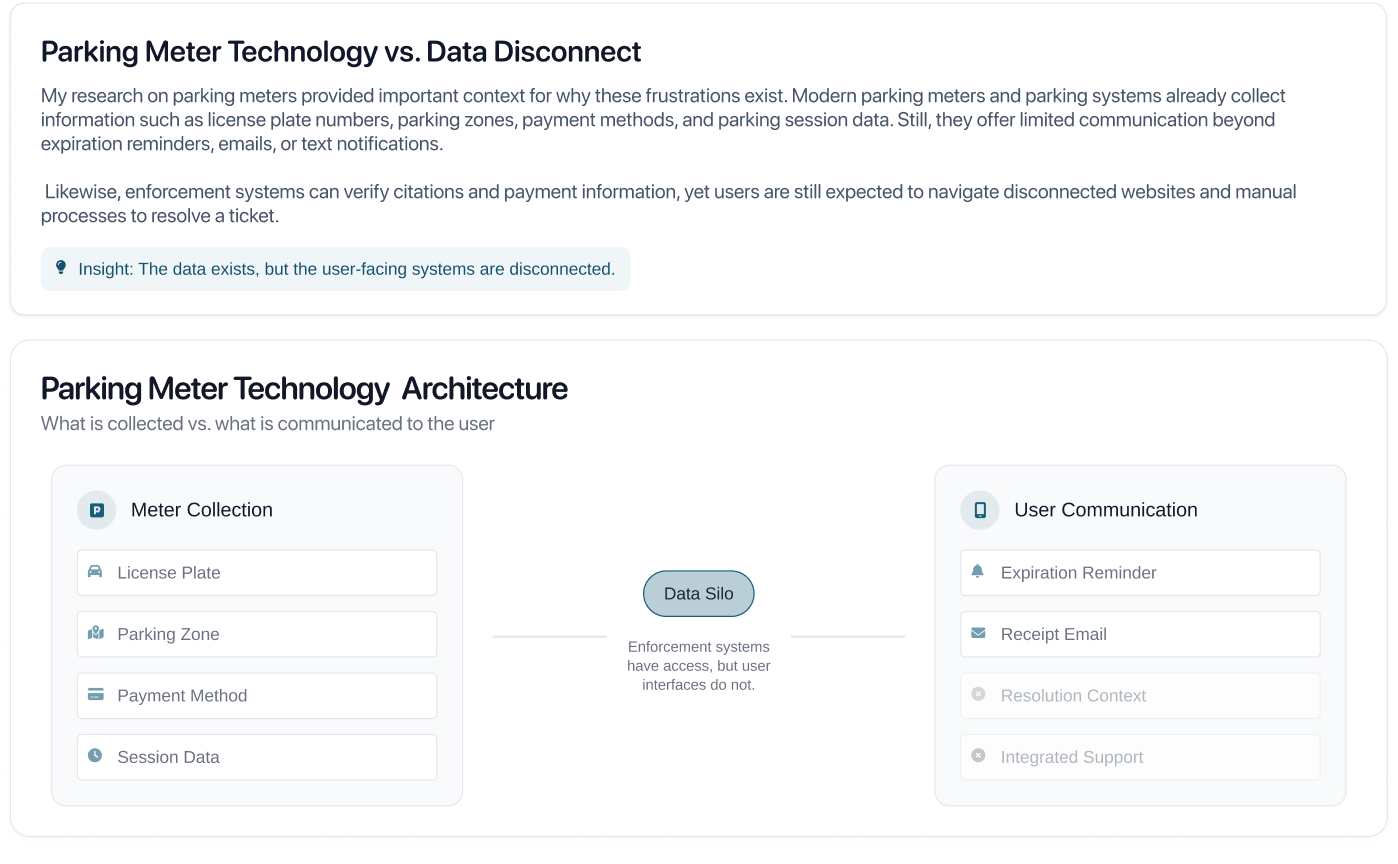
Research with 39 participants, combined with an analysis of modern parking meter systems, revealed that the biggest challenge isn't paying a parking ticket—it's navigating the fragmented experience surrounding it. Users consistently struggled with financial concerns, inefficient processes, limited support, and outdated product experiences. These insights, together with the technical capabilities and limitations of current parking meter technology, uncovered an opportunity to design an AI-powered solution that proactively guides users through locating, managing, paying, or disputing parking tickets with greater speed, clarity, and confidence.
From Research to Product Opportunity
After analyzing the survey responses and researching how parking meter systems operate, I synthesized the findings to identify where user needs intersect with technical constraints. Rather than viewing the research as two separate data sets, I looked for opportunities where technology could reduce friction without requiring major changes to existing parking infrastructure.
By combining all findings of user research and parking meter technology, I identified a clear product opportunity: instead of asking users to adapt to fragmented government systems, an AI-powered assistant could become the central point of interaction. The concept would help users quickly locate parking tickets, explain violations in plain language, answer questions instantly, guide users through payment or dispute workflows, and surface the most relevant information before late fees accumulate.
This synthesis established the strategic direction for ParkerPlus AI—transforming a traditionally reactive, confusing process into a proactive, guided experience that reduces user effort while working alongside existing parking and citation systems rather than replacing them.
Aggregated Empathy Mapping
To better understand the parking ticket experience, I synthesized insights for three representative persona types—Peter, Marshall, and Monica. Although their backgrounds, careers, and locations differ, they shared many of the same frustrations. They wanted a faster, more transparent way to locate, pay, or dispute parking tickets without navigating confusing government systems.
Across all three personas, four common themes emerged: financial stress from accumulating late fees, inefficient processes that required unnecessary time and effort, inconsistent digital experiences across municipalities, and limited support when questions or disputes arose. These shared insights became the foundation for designing ParkerPlus AI as a guided, AI-powered experience that simplifies ticket resolution, improves transparency, and helps users take action with confidence.


What I learned
After reviewing the data of all the users, I discovered they experience the most frustration after receiving a parking ticket, when they must navigate unclear processes, locate accurate information, determine their options, and complete a resolution on their own.
Every user has a different circumstance, but they all share three major needs:
Greater transparency - users want immediate access to accurate ticket information, clear explanations of violations, and visibility into payment or dispute status.
Simpler resolution processes - whether disputing a ticket, submitting evidence, or making a payment, users struggle with disconnected systems, outdated websites, and unnecessary steps that increase time and effort.
More guidance and flexibility - users need support that fits their schedules and situations, including digital assistance, proactive reminders, virtual dispute options, and multiple ways to complete tasks.
Market Opportunity
Unlike today's parking apps, which focus primarily on finding and paying for parking, I strategized an idea that fills an untapped market by becoming the first platform dedicated to end-to-end parking ticket management. I have no doubt that this approach would be transforming an age old government process into a seamless experience.


Heavy User Challenges
Users repeatedly encountered friction not because paying or disputing parking tickets is difficult, but mainly because outdated government websites make simple tasks unnecessarily complex! Confusing navigation, excessive clicks, inconsistent systems between cities, poor mobile responsiveness, and limited dispute guidance turn a straightforward process into a huge frustrating experience—creating an opportunity for me to rethink the experience with a faster, AI-powered solution that benefits both users and the business.
Solution: ParkerPlus AI
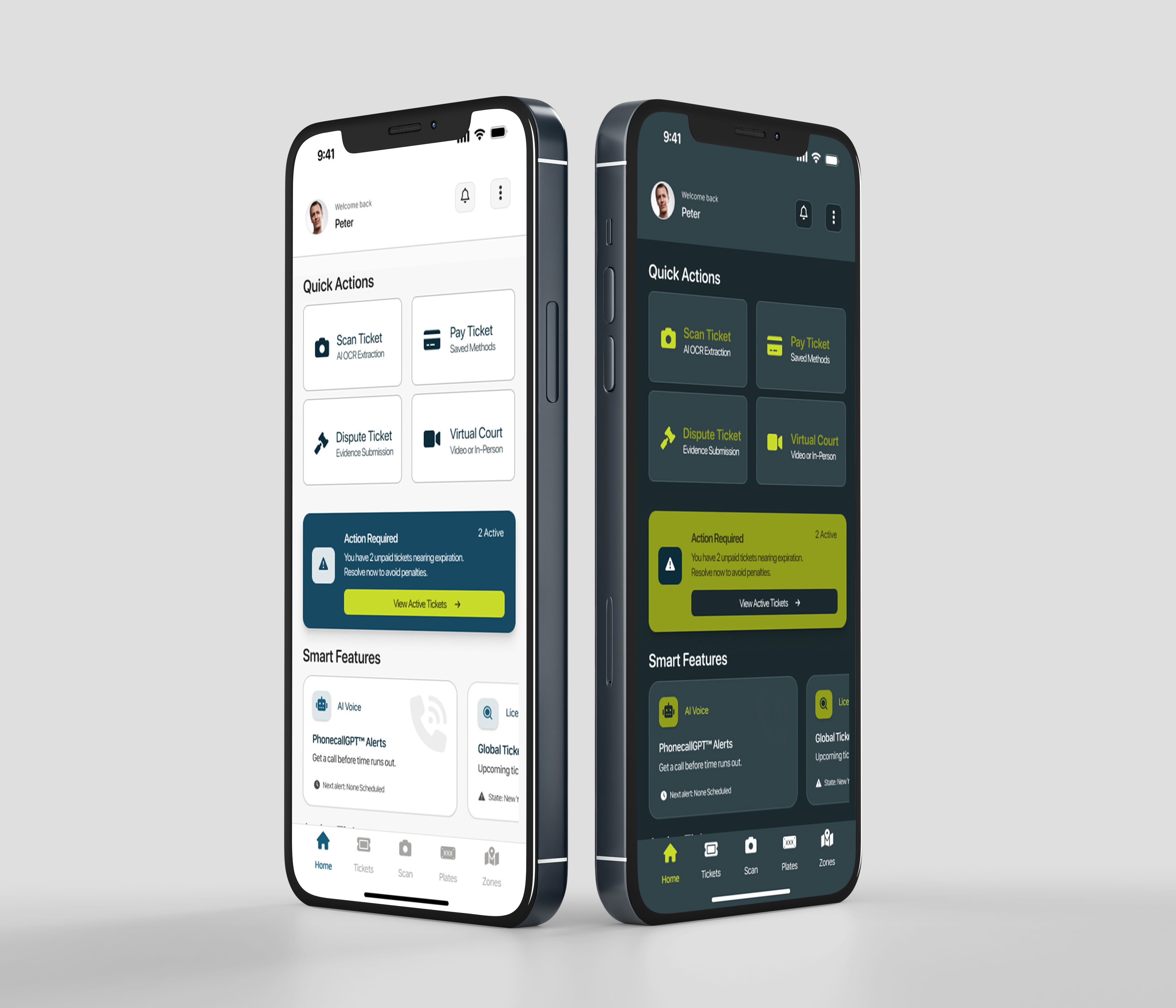
ParkerPlus AI is an AI-powered parking assistant that transforms the frustrating experience of managing parking tickets into a seamless, intelligent workflow. I decided that users should be able to simply scan a parking ticket, and the app instantly analyzes the violation, explains it in plain language, and guides them through the fastest path to either pay or dispute it.
For disputes, ParkerPlus AI generates a personalized AI-assisted argument based on the violation details and streamlines the court process by allowing users to choose an in-person or virtual hearing that fits their schedule. My motives were to eliminate outdated government workflows, and have ParkerPlus AI empower users to resolve parking violations in minutes instead of hours.
AI Smart Features:
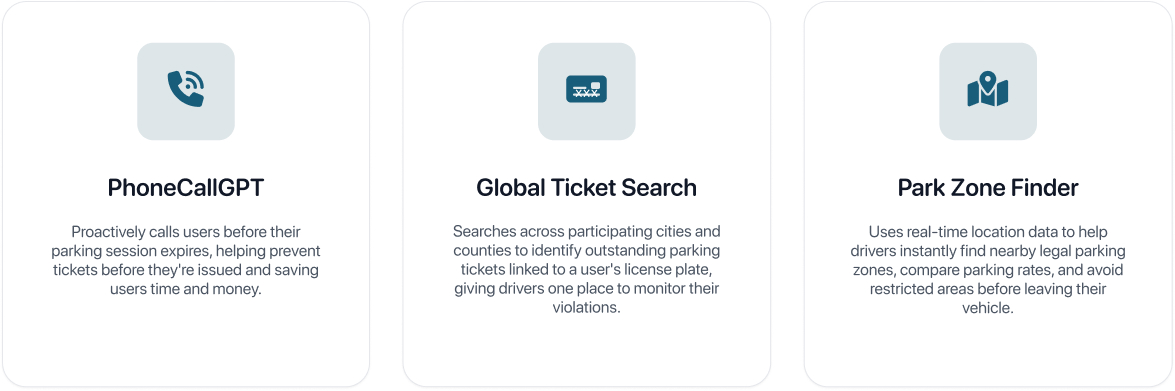
ParkerPlus AI goes beyond helping users resolve parking tickets—it proactively helps them avoid future violations. Being on the forefront of an AI era, I include a suite of intelligent features that keeps drivers informed, prepared, and one step ahead by preventing expired parking sessions, centralizing ticket management across jurisdictions, and making it easier to find legal parking before a violation ever occurs. Together, these features transform ParkerPlus AI from a reactive solution into a proactive parking companion.
Business Impact
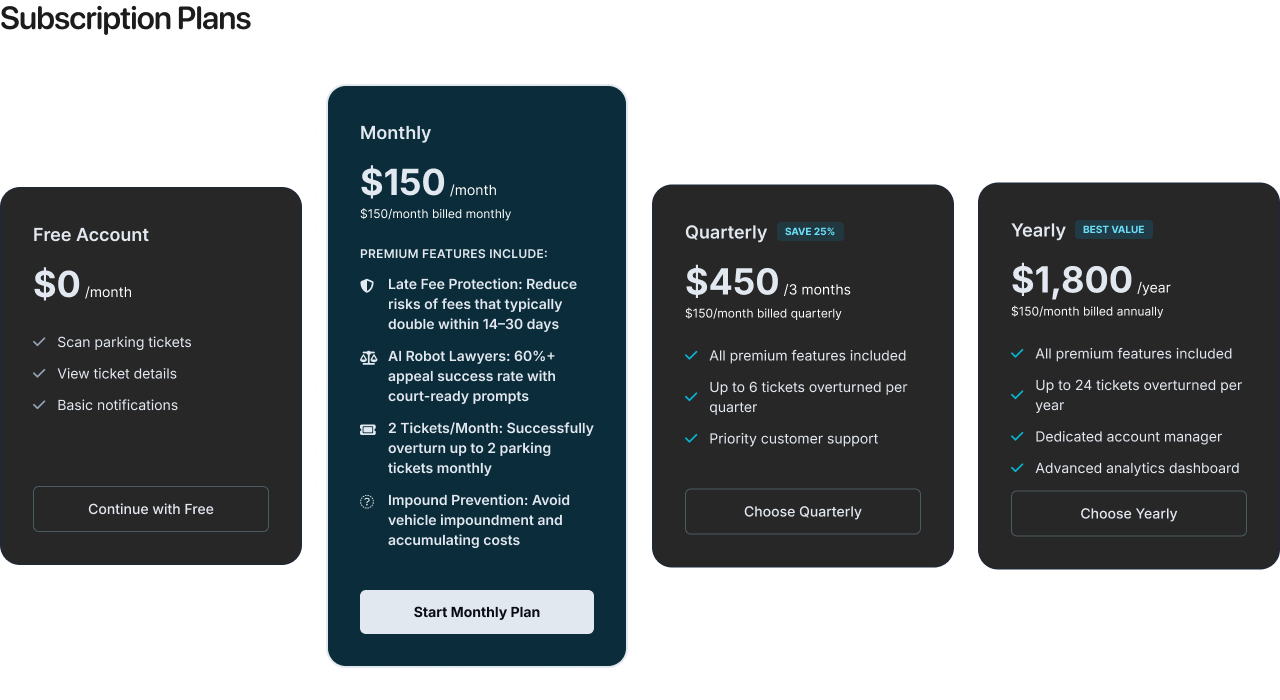
ParkerPlus AI creates value for both users and the business by reducing the time and frustration associated with parking violations while generating recurring revenue through subscription plans. The platform evolves from a parking ticket management tool into a proactive AI mobility assistant—helping users avoid tickets before they happen while establishing a scalable, subscription-based business model with long-term customer retention.
Value Proposition
ParkerPlus AI delivers measurable value by helping users resolve parking tickets faster, reduce financial penalties, and navigate an otherwise fragmented government process with confidence. By combining AI-powered ticket analysis, dispute preparation, and guided court assistance, the platform transforms a stressful administrative task into an efficient, user-centered experience while creating a scalable subscription business with recurring revenue.
1. Fast Ticket Resolution:
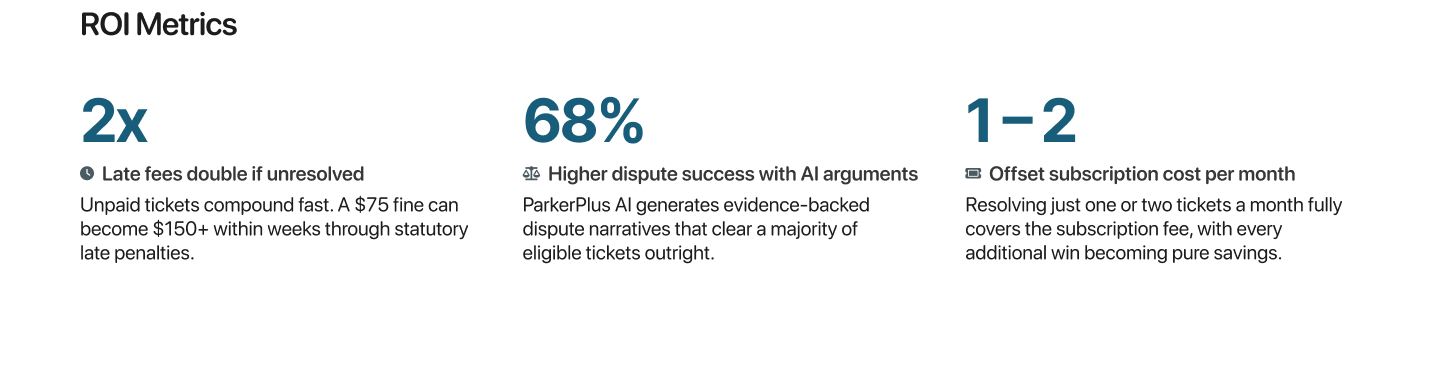
Parking citations often incur late fees that can double the original fine within 14–30 days if left unresolved. ParkerPlus AI minimizes this risk by instantly analyzing tickets, notifying users of critical deadlines, and providing immediate options to pay or dispute violations before additional penalties accumulate.
2. Higher Dispute Success Rates:
Recent advancements in AI-assisted legal technologies have demonstrated appeal success rates exceeding 60%, while specialized systems have reported 90%+ favorable outcomes through ticket dismissals or fine reductions in specific use cases. ParkerPlus AI leverages these advancements by generating personalized dispute strategies and evidence-backed prompts that empower users to confidently present their case during virtual or in-person hearings, significantly improving their likelihood of a favorable outcome.
3. Clear Financial Return for Users:
For frequent drivers in major metropolitan areas, ParkerPlus AI's $150 monthly subscription can quickly pay for itself. Successfully preventing, reducing, or dismissing just one to two parking tickets each month can offset the subscription cost while helping users avoid escalating fines, vehicle impoundment, collection actions, and the long-term financial burden associated with unresolved citations.
Business Value
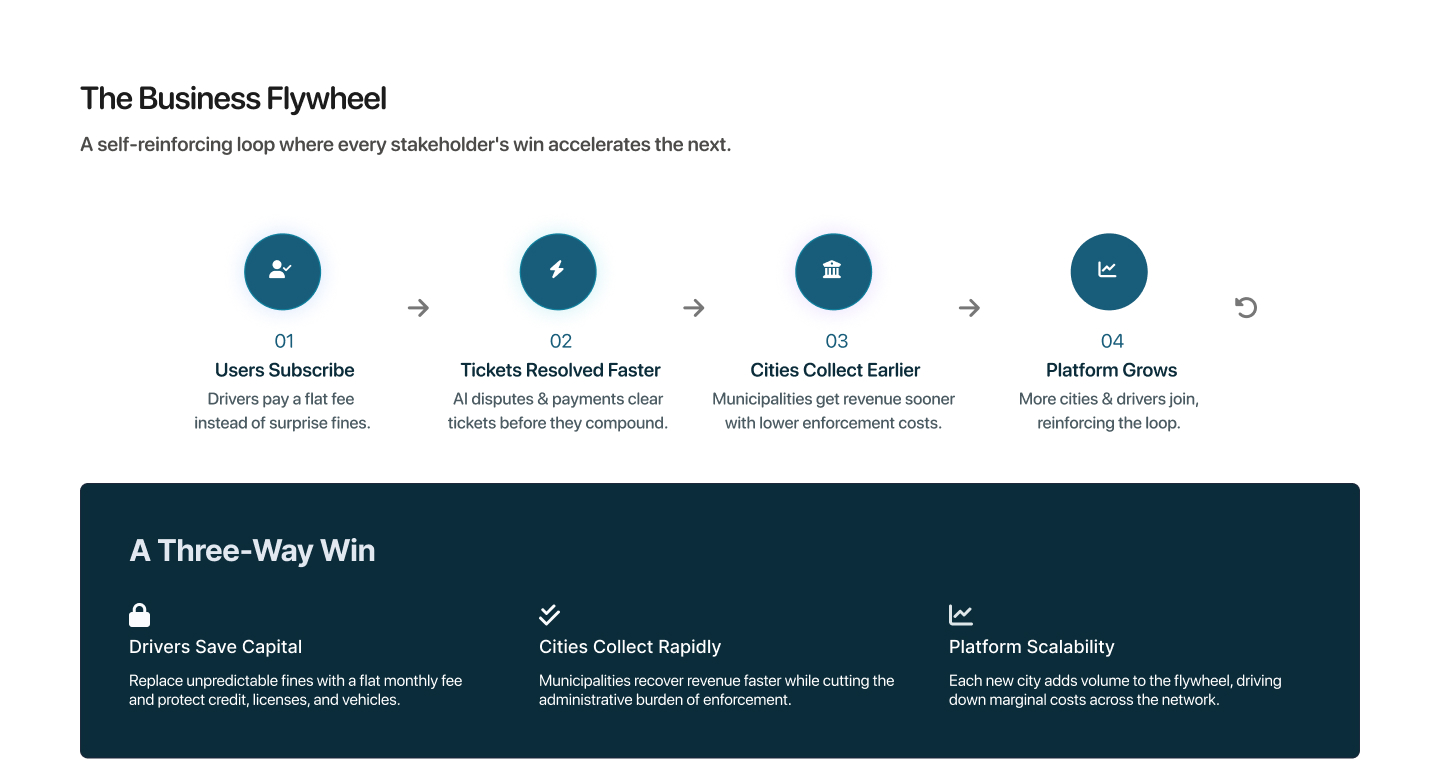
Beyond benefiting individual users, ParkerPlus AI creates a sustainable recurring revenue model through monthly, quarterly, and annual subscriptions. At the same time, it serves as a technology partner for municipalities by accelerating ticket resolution and encouraging earlier payments, resulting in faster case closures and a more predictable flow of parking revenue. This creates a mutually beneficial ecosystem where users save time and money, municipalities improve operational efficiency, and ParkerPlus AI generates scalable, recurring revenue through a high-value service.

Info Architecture
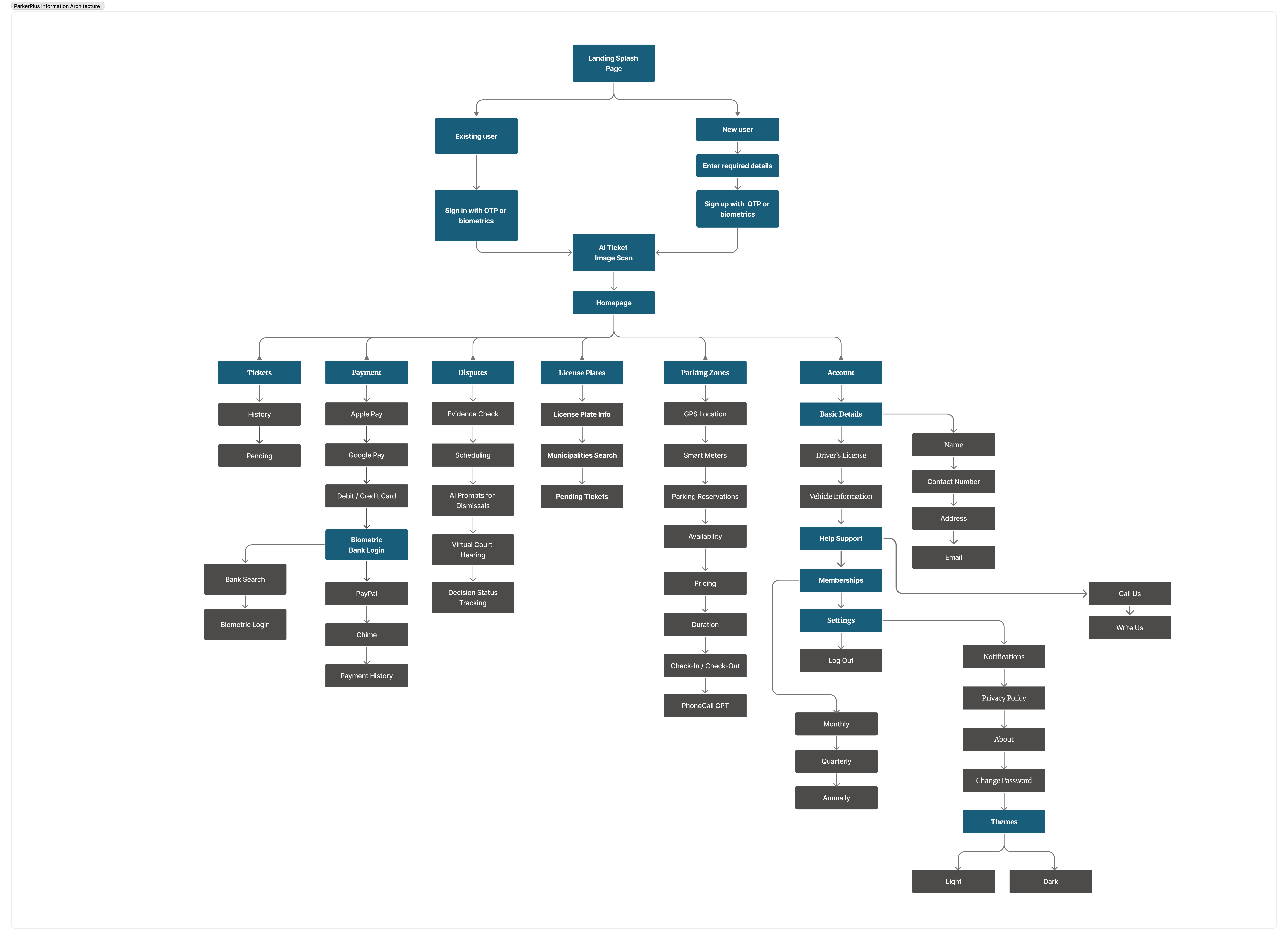
This sitemap outlines a streamlined user journey from onboarding to parking ticket resolution. After signing in or creating an account, users can scan a parking ticket to access a centralized dashboard with six primary features: Tickets, Payments, Disputes, License Plates, Parking Zones, and Account. The architecture also includes membership management, settings, notifications, and customer support, ensuring users can efficiently manage every aspect of their parking experience through one intuitive, AI-powered platform.
Low-Fidelity
These wireframes establish the foundation for ParkerPlus AI prioritizing usability, navigation, and task efficiency before focusing on visual design. I designed each screen around the core user goals identified during my research — quickly scanning, paying, or disputing parking tickets with minimal effort. They also validate the application's information architecture, user flows, and feature placement, ensuring users could complete their tasks with fewer interactions and less cognitive load. This iterative process helps refine the experience early, resulting in a streamlined, intuitive interface that directly addressed both user pain points and business objectives.

Usability Testing Findings
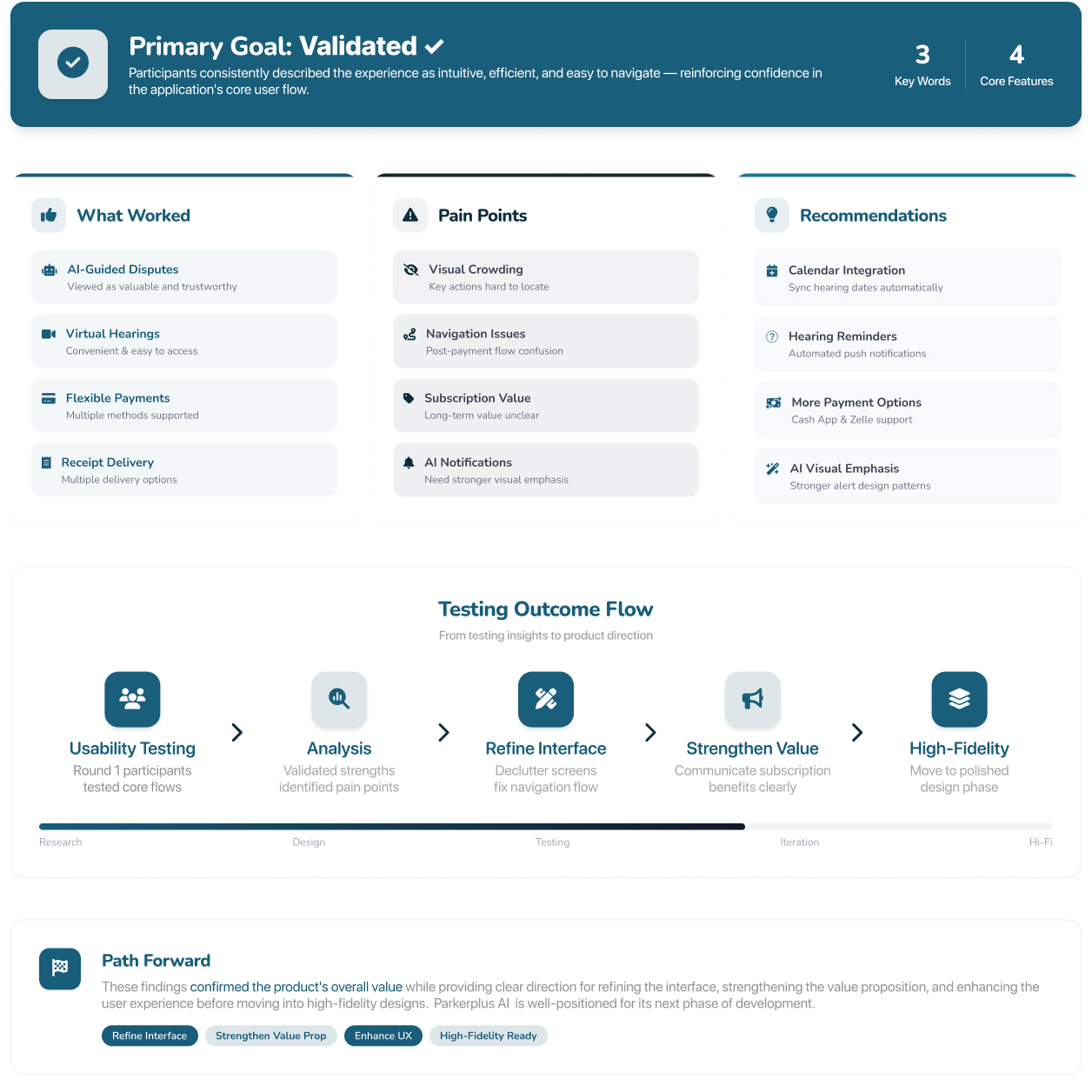
My first round of usability testing validated that ParkerPlus AI successfully addressed its primary goal of simplifying parking ticket management. Participants consistently described the experience as intuitive, efficient, and easy to navigate, reinforcing confidence in the application's core user flow. Features such as AI-guided ticket disputes, virtual hearing options, flexible payment methods, and multiple receipt delivery options were viewed as valuable and trustworthy.
Testing also uncovered opportunities for me to improve the prototype. Some users found certain screens visually crowded, making key actions like paying a ticket harder to locate, while others experienced minor navigation issues after completing payments. Participants also questioned the long-term value of a subscription model, suggesting the need to better communicate ParkerPlus AI's benefits beyond individual ticket resolution. Additional recommendations included calendar integration, automated hearing reminders, expanded payment options such as Cash App and Zelle, and stronger visual emphasis for AI notifications.
These findings confirmed my product's overall value while providing clear direction for refining the interface, strengthening the value proposition, and enhancing the user experience before I move into high-fidelity designing.

Prototyping & Usability
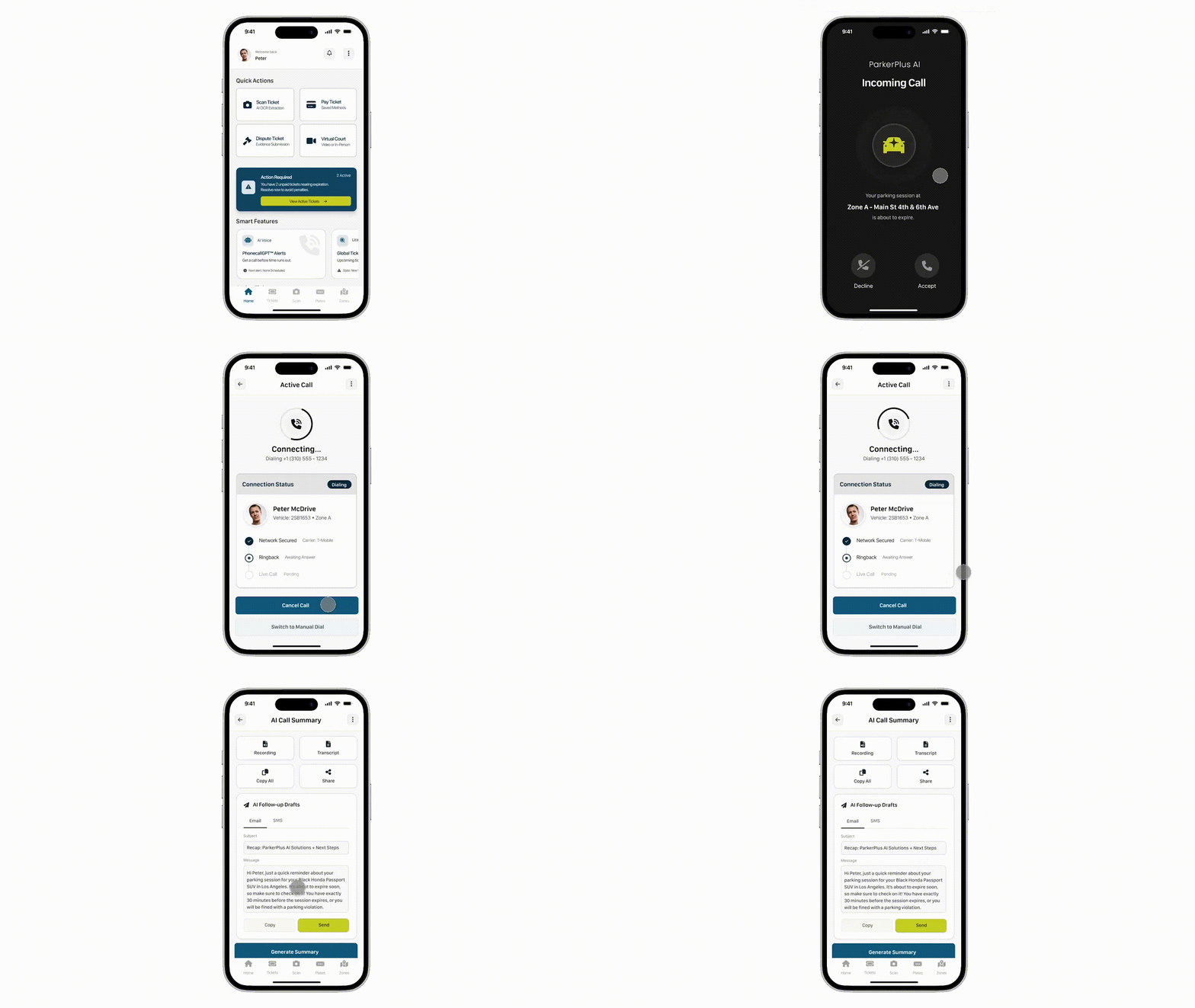
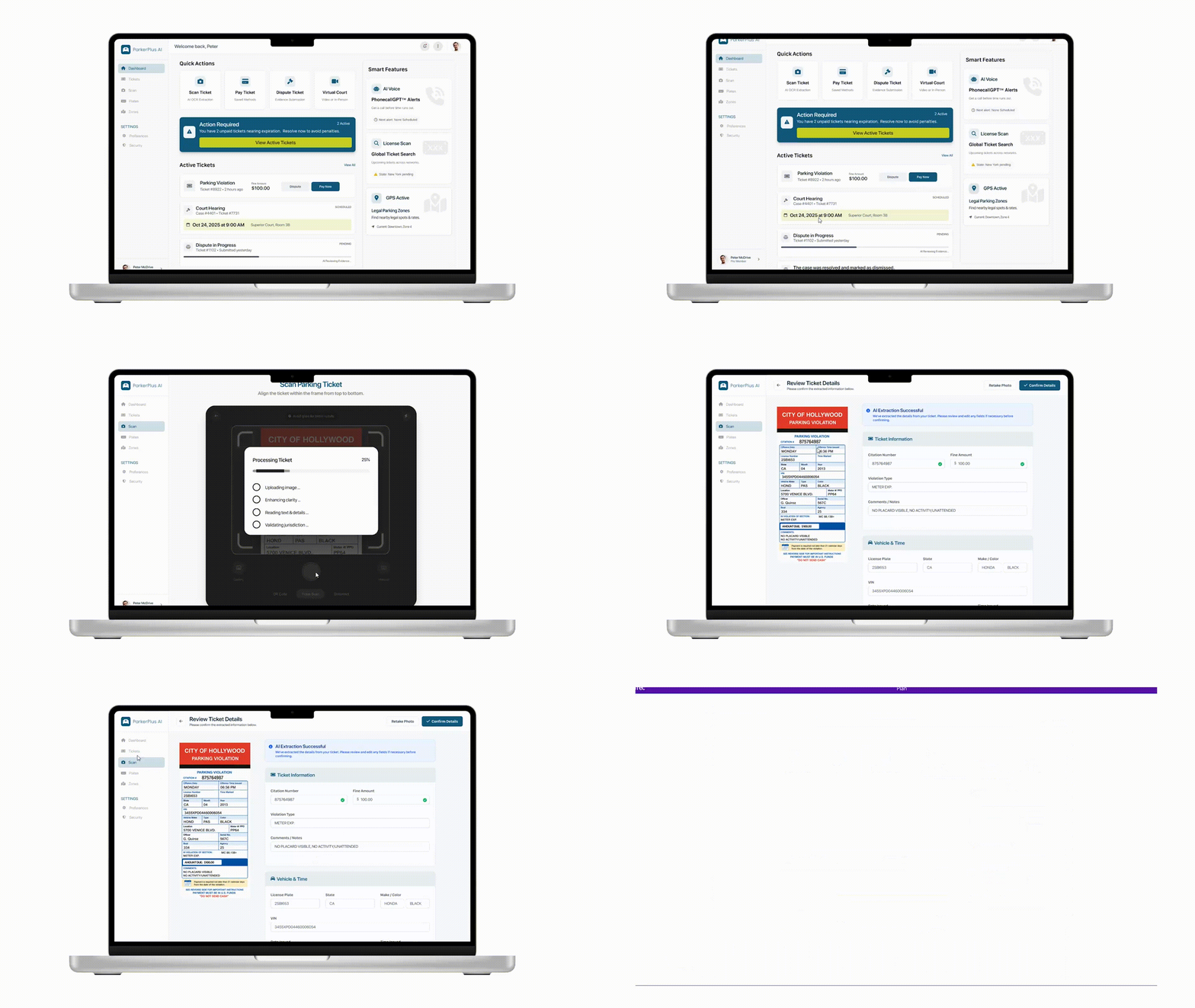
The 2nd and 3rd round of usability testing for the high-fidelity prototypes demonstrated that ParkerPlus AI successfully translated user research into an intuitive, production-ready experience. Participants completed the ticket resolution process without confusion or friction, validating the application's streamlined navigation and user-centered design. A standout insight was users' confidence in the AI experience—they appreciated being able to review, verify, and edit AI-generated information before taking action. This level of transparency increased trust in the system while reinforcing ParkerPlus AI's role as an intelligent assistant that keeps users in control of their parking ticket decisions.
1. Paying for a Parking Ticket
2. Disputing a Parking Ticket
3. PhoneCallGPT
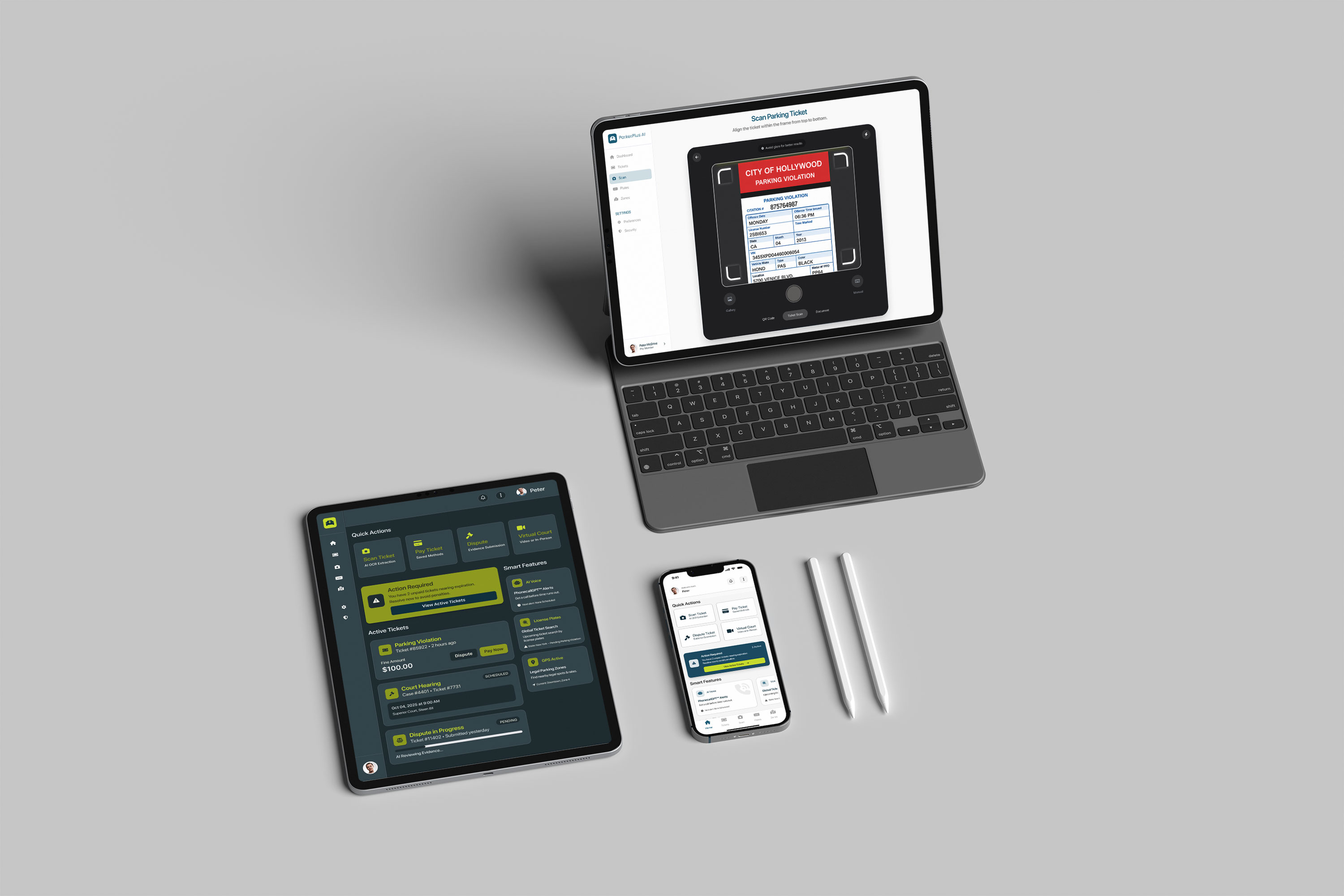
2. Desktop Version

Concluding Insights
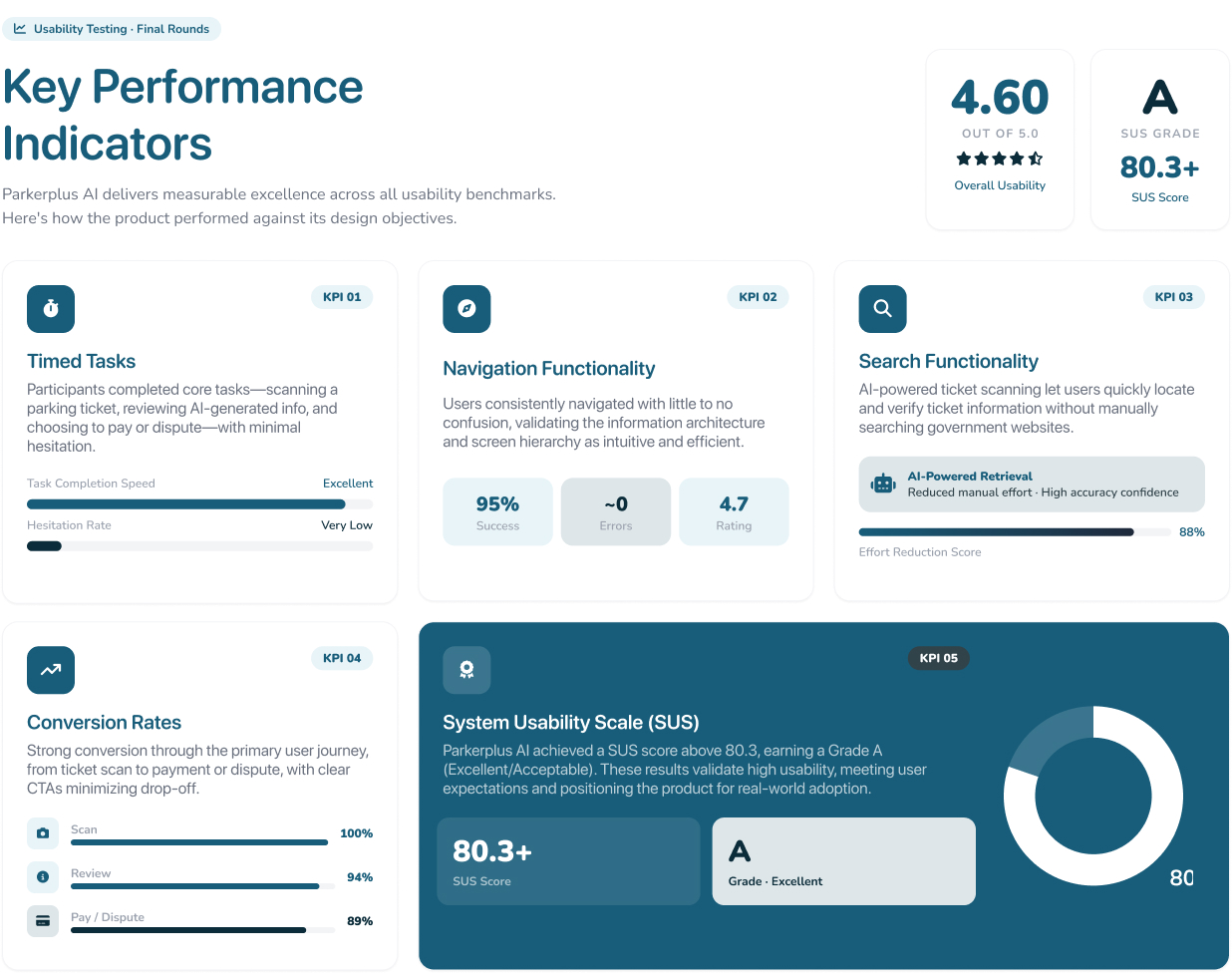
The final round of usability testing confirmed that ParkerPlus AI successfully achieved its core design objective: creating a fast, intuitive, and trustworthy parking ticket management experience. My participants consistently praised the application's visual hierarchy, clear calls-to-action, and comprehensive feature set, validating that this product effectively supports users through the ticket resolution process.
More importantly, the final testing identified opportunities for me to refine—not redefine—the experience. The feedback specified reducing information density, supporting multiple vehicles, and addressing a minor scanning issue provided actionable insights that strengthen scalability and usability without changing the core product direction.
This iterative testing process demonstrates my strategic, user-centered design approach: validating assumptions early, translating user feedback into meaningful design improvements, and I continuously refined the product until it aligned with both user needs and business goals. The result is that ParkerPlus AI stands as a solution shaped by my research, validated through my usability testings, and I designed it to solve a real-world problem with confidence and clarity.
Handoff
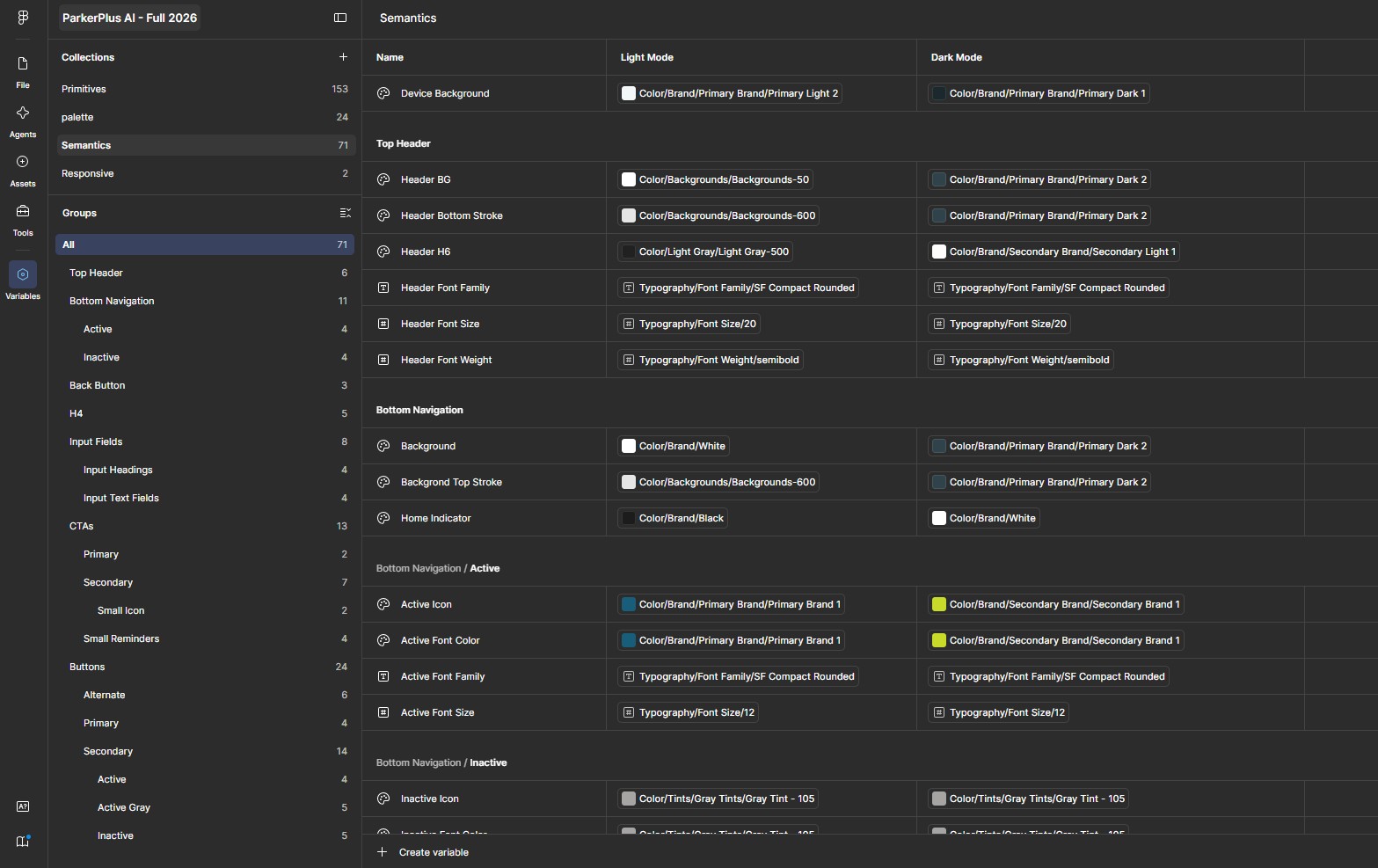
The handoff that I prepared for ParkerPlus AI has been developed with establishing a scalable design system with reusable variables for light and dark modes, along with responsive layouts for mobile, tablet, and desktop experiences. While the development is still in progress, this product is still being designed with implementation in mind for continued engineering, quality assurance, and compliance with Apple App Store and Google Play Store guidelines prior to launch.